Prehistoric rock art hidden in a public Spanish cave for 26,000 years

Headline and summary by local AI
Archaeologists at the Catalan Institute of Human Paleoecology and Social Evolution (IPHES-CERCA) identified hundreds of Palaeolithic rock-art engravings in the Cova de la Font Major in Catalonia, Spain.
The cave had been open to the public for 70 years and served as a museum since the 1990s, yet the ancient carvings remained unnoticed by many visitors. Josep Maria Vergès Bosch and Míriam Salas-Altès discovered the motifs during a 2019 excavation.
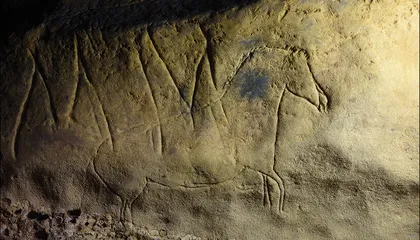
The team identified 280 Palaeolithic art motifs, which include 55 depictions of animals such as horses, bears, and aurochs, which are the ancestors of domestic cattle. The artists also utilized natural fissures in the cave walls to create their work, such as using a crack to represent the ground beneath a horse. The etchings were difficult to detect because they are hard to see under direct light.
Researchers noted that viewers must angle light from different directions to reveal the depressions in the rock. This discovery changes the understanding of the region, which was previously thought to lack Palaeolithic art.
Selected and summarized by local AI How we work
Discovery: Archaeology, new knowledge of art, culture and history, forgotten history uncovered, something lost restored.