Ancient mastodon tooth discovered in California creek
Summary and headline written by AI from the source article. How we work
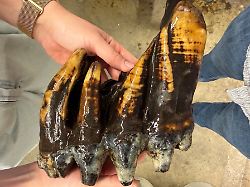
Brigid Lynch, a geomorphologist in California, discovered an 11,000-year-old mastodon tooth while searching for habitat for an endangered frog.
Lynch found the tooth in a creek south of San Francisco and quickly realized its significance. Paleontologist Wayne Thompson described the tooth as the most complete and spectacular mastodon tooth from the region he had ever seen, noting its pristine condition.
The tooth belonged to a Pacific mastodon (Mammut pacificus), a species recognized as distinct from the American mastodon because of differences in its teeth, leg bones, and tusks. Researchers believe Pacific mastodons lived across present-day California, Oregon, parts of Mexico, and the northern Rocky Mountain region of the western United States. These large herbivores roamed the area during the Pleistocene epoch, which ended around 11,700 years ago. Unlike mammoths that ate grasses, mastodons primarily ate leaves and vegetation from trees.
Scientists study fossils like this one to learn about past ecosystems and biodiversity, and to inform conservation efforts for the future.