Last inca bridge rebuilt annually in Peru’s Andean highlands
Summary and headline written by AI from the source article. How we work
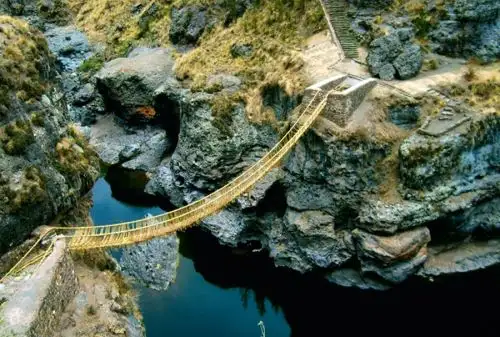
Communities in Quehue district, Cusco, Peru, continue a tradition over 600 years old by rebuilding the Q’eswachaka, the last remaining Inca suspension bridge.
Every year, around 1,000 people from the Quechua communities of Huinchiri, Chaupibanda, Choccayhua and Ccollana Quehue work together to renew the bridge, which spans a canyon over the Apurímac River at an altitude of over 3,700 meters.
The Q’eswachaka gets its name from the Quechua words for “rope” and “bridge.” Villagers construct the 28-meter-long, 1.2-meter-wide bridge entirely from locally-grown plant fibers, weaving them into ropes of varying thicknesses. This process embodies a traditional Inca system of communal cooperation called Minka, where people assist each other. The four-day rebuilding process begins with a ceremony honoring Pachamama (Mother Earth) and local deities.
Women braid the plant fibers into cords, while men then combine these into larger, stronger cables called makis to support the bridge. Experts known as Chakaruwak, who inherit construction knowledge from their ancestors, oversee the assembly and ensure the bridge’s structural integrity. In 2013, UNESCO designated the knowledge, techniques, and rituals surrounding the Q’eswachaka’s annual renewal as an Intangible Cultural Heritage of Humanity, recognising its importance to the communities’ identity and connection to their history.