Early humans gave up tree-climbing by 1.8 million years ago
Summary and headline written by AI from the source article. How we work
Paleoanthropologists from the University of the Witwatersrand in South Africa and the University of Southern California studied fossils to understand when human ancestors stopped climbing trees and began walking upright.
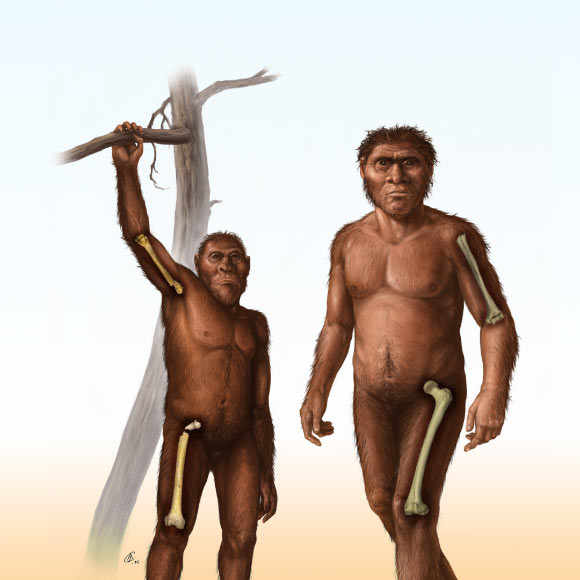
Researchers examined the strength of limb bones from Little Foot, a 3.67-million-year-old Australopithecus fossil found in South Africa, and an early Homo individual from Dmanisi, Georgia, dating to around 1.8 million years ago.
They compared these fossils to modern humans and apes, using bone strength ratios as indicators of how much time each species spent in trees. The team discovered that Little Foot’s arms and legs suggested it still climbed trees frequently, even with a larger body size than other Australopithecus individuals. Its lower leg bones showed some human-like traits, hinting at a combination of tree-climbing and walking.
In contrast, the Homo individual from Dmanisi had limb strength proportions similar to modern humans, indicating it primarily walked on two legs and rarely climbed trees. This difference suggests that early Homo species had fully adapted to terrestrial life by 1.8 million years ago, abandoning regular tree-climbing. Researchers believe this shift may be connected to changes in how these early humans searched for food and the distances they traveled, rather than the development of tools.
They also noted this change occurred during a period of increasing brain size in the human lineage, though they do not claim a direct cause-and-effect relationship.