Scientists identify new pterosaur species in England to map ancient migration
Headline and summary by local AI
Paleontologists from Universidade Federal do ABC identified a new species of tapejarid pterosaur from a fossil held at the Sedgwick Museum of Earth Sciences in Cambridge, England.
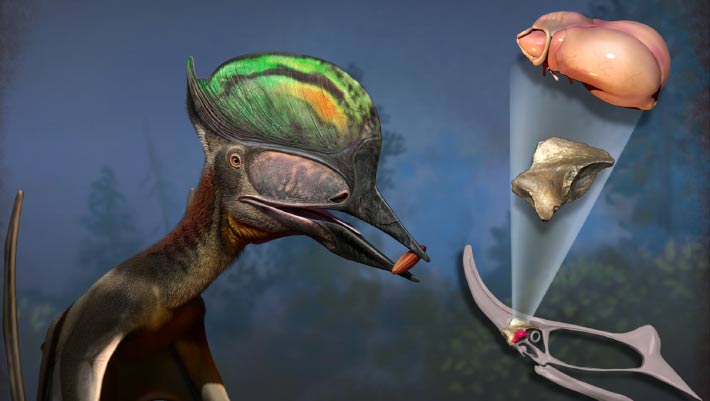
This discovery suggests that these prehistoric flying reptiles, which were previously linked mostly to Brazil, had deep roots in Europe. The researchers named the new species Hintighernia edingerae. It lived in Britain during the Cretaceous period, between 105 and 100 million years ago.
Tapejarids are known for their short, downturned snouts and distinctive head crests. Scientists believe these creatures might have been omnivorous or even fed on fruit and plants. The team used micro-CT scanning to create a digital model of the braincase of Hintighernia edingerae. They found that its brain structure closely resembles that of Tapejara wellnhoferi, a species from Brazil. This similarity points to a close evolutionary relationship between the two.
The study also led the team to reclassify an older specimen, Ornithostoma sedgwicki, as a different type of pterosaur. The researchers suggest that Europe served as a major center for the early diversity of tapejarids. They believe these creatures may have spread from Europe to North Africa and eventually to South America and East Asia. This theory aligns with the Eurogondwana hypothesis, which describes ancient land connections between these continents.
Selected and summarized by local AI How we work
Discovery: Archaeology, new knowledge of art, culture and history, forgotten history uncovered, something lost restored.