Nile Shifts Shaped Ancient Kush
Why this is here: The team collected sediment cores averaging 8 centimeters in diameter, allowing them to analyze layers of Nile flood deposits spanning thousands of years.
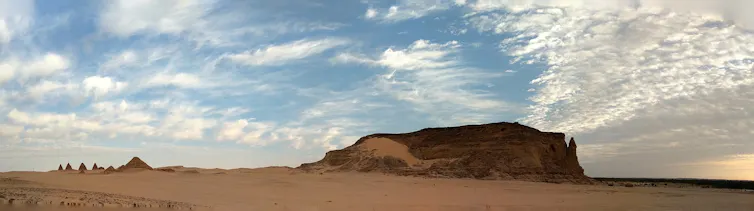
An archaeological team led by a researcher beginning work in 2018 investigated how the Nile River’s changing landscape influenced the ancient Kushite empire in northern Sudan. The team—including geomorphologists Jan Peeters and Tim Winkels—analyzed 26 sediment cores, up to 26 feet deep, collected from the Nile Valley near Jebel Barkal. These cores revealed that a Nile channel once flowed close to the city around 10,000 years ago, but had filled in by 2000 B.C.E., when Kush began to flourish.
The researchers found evidence the floodplain gradually built up due to consistent Nile flooding from 2000 B.C.E. to the early 20th century. This fertile land supported agriculture throughout much of the city’s history. Local man Hatim Awad Abdullah shared family knowledge of past Nile flooding patterns, contributing to the team’s understanding.
The study suggests abundant rains and predictable Nile floods supported Kush’s growth, but doesn’t explain the city’s eventual decline. Further research is needed to fully understand how the ancient inhabitants managed their water supply and adapted to environmental changes.
Surfaced by the Discovery lens — one of the vital signs ovr.news reads.
How we evaluated this
AI summary
read the original for the full story — Read on theconversation.com . How we work →