Jacquard Loom Linked to Early Computing
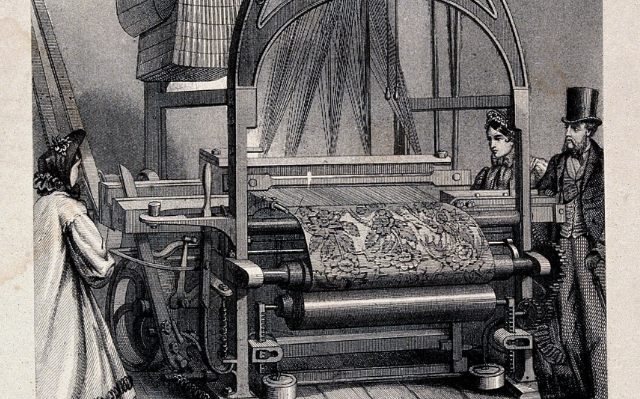
Why this is here: Ada Lovelace wrote an algorithm in 1843 that is now recognized as the first computer program in history.
In Lyon, France, textile merchant Joseph-Marie Jacquard presented his newly patented Jacquard loom to British society in 1804. The loom used punched cards to automate the weaving of complex patterns, significantly reducing production time and labor costs. Roughly forty years later, Ada Lovelace, considered the first computer programmer, drew a comparison between the Jacquard loom and her analytical engine prototype, recognizing a shared logic of instruction.
The Jacquard loom initially faced resistance from silk weavers fearing job loss, with some machines even destroyed. However, it gained acceptance and spread from England to other parts of the world by 1820.
Lovelace noted in 1843 that the analytical engine “weaves algebraic patterns” just as the Jacquard loom weaves flowers. Punched cards continued as a data input method for computers until the mid-20th century.
Contemporary artists continue to explore the connections between textiles and technology. Irene Posch created a knitted radio, and she and Ebru Kurbak built an 8-bit computer using embroidery techniques.
These artists suggest that artistic research can reveal overlooked skills and materials. The full implications of this historical relationship remain open to further investigation.
Surfaced by the Discovery lens — one of the vital signs ovr.news reads.
How we evaluated this
AI summary
read the original for the full story — Read on nexojornal.com.br . How we work →