Indium-Free Tandem Solar Cell Achieves 31% Efficiency
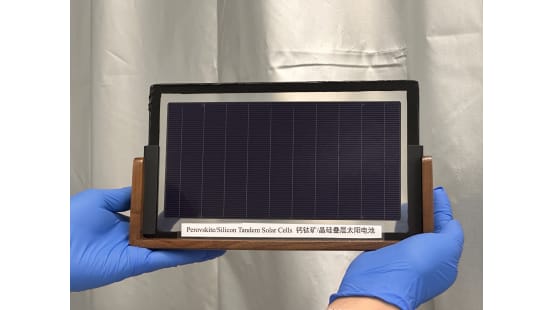
An international team of scientists fabricated a 31%-efficient indium-free perovskite-silicon tandem solar cell mini-module using a reactive plasma deposition process. The researchers replaced the traditionally used indium with tin oxide, a material costing roughly 1% as much. This new process uses lower-energy particles during deposition, minimizing damage to the sensitive perovskite layers and creating dense, conductive oxide films.
The team certified an efficiency of 33.6% on a 1 cm² device and successfully scaled the technology to a 207.9 cm² mini-module. Testing revealed the devices maintained strong performance after exposure to heat, humidity, and over three months of outdoor operation, retaining 65% of initial efficiency after 105 days.
This breakthrough demonstrates the potential for large-area, high-efficiency solar cells without relying on scarce and expensive materials, paving the way for more cost-effective and sustainable photovoltaic technologies.
Surfaced by the Solutions lens — one of the vital signs ovr.news reads.
How we evaluated this
AI summary
read the original for the full story — Read on pv-magazine.com . How we work →