Greek Fire: Byzantium’s Ancient Incendiary Weapon
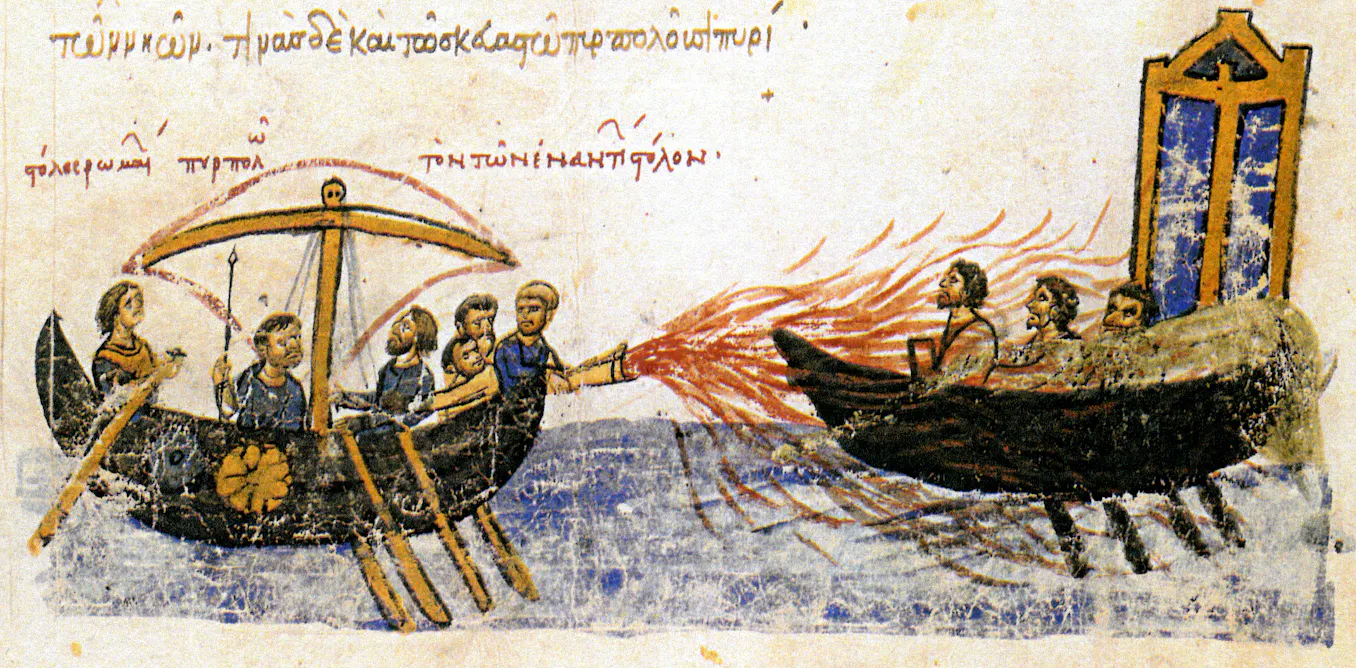
Byzantine fleets deployed a devastating incendiary weapon known as Greek fire from around 673 CE to the 1180s, giving them a crucial advantage in naval battles in the Eastern Mediterranean. The secret recipe for this liquid, sprayed from siphons mounted on ships, died with the fall of the Byzantine Empire to the Ottomans in 1453.
Historians believe it was a combustible liquid that stuck to surfaces, even water, and couldn’t be extinguished. Kallinikos, a Jewish architect, is credited by some sources with inventing or improving Greek fire around 673 CE, successfully deploying it against Arab fleets besieging Constantinople.
Byzantine emperors guarded the formula closely, believing it was divinely inspired and limiting its knowledge to Christians within their empire, with tales of divine retribution befalling those who revealed its secrets. Though the exact composition remains unknown, modern researchers suggest a combination of crude oil from the region between the Black Sea and Caspian Sea, mixed with pine resin or oil, may have formed the basis of the weapon.
Its legacy extends beyond history, inspiring the fictional "wildfire" in George R.R. Martin’s Game of Thrones.
Surfaced by the Discovery lens — one of the vital signs ovr.news reads.
How we evaluated this
AI summary
read the original for the full story — Read on theconversation.com . How we work →