Math’s Langlands program connects diverse fields
Summary and headline written by AI from the source article. How we work
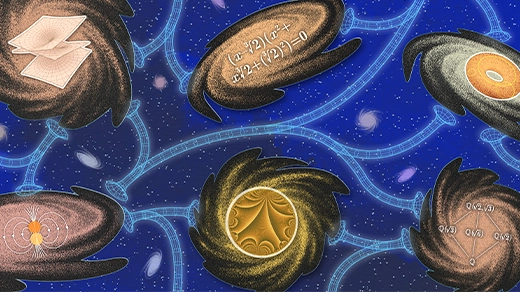
Robert Langlands, a Canadian mathematician, initiated the Langlands program in 1967 by noticing a connection between number theory and harmonic analysis, the study of signals and waves. He proposed that corresponding relationships exist between different mathematical areas, suggesting a unified structure within mathematics.
Langlands began with the rational numbers and explored how extending them with solutions to polynomial equations created symmetries. These symmetries, described by Galois groups, revealed information about the equations themselves.
He then connected these Galois groups to modular forms, objects studied in harmonic analysis that represent patterns in signals and waves. Mathematicians have since worked to prove these connections, called Langlands correspondences, in various mathematical fields. For example, proving a Langlands-like correspondence was key to solving Fermat’s Last Theorem after 357 years. The program’s complexity leads experts to describe it differently, often using analogies like the parable of the blind men and the elephant.
Recent work, including a set of 800-page papers published in 2024, has proven instances of the geometric Langlands correspondence. Some researchers believe the correspondences represent different facets of a deeper, yet undiscovered, mathematical object, while physicists have suggested these correspondences might reflect dualities within quantum theories, hinting at a fundamental connection between mathematics and the physical universe.


/https://tf-cmsv2-smithsonianmag-media.s3.amazonaws.com/filer_public/07/c7/07c76340-2db9-4c7c-a8d4-732053b0e7e0/sarcophilus_harrisii_taranna.jpeg)