AI Echoes Forgotten Memory Research
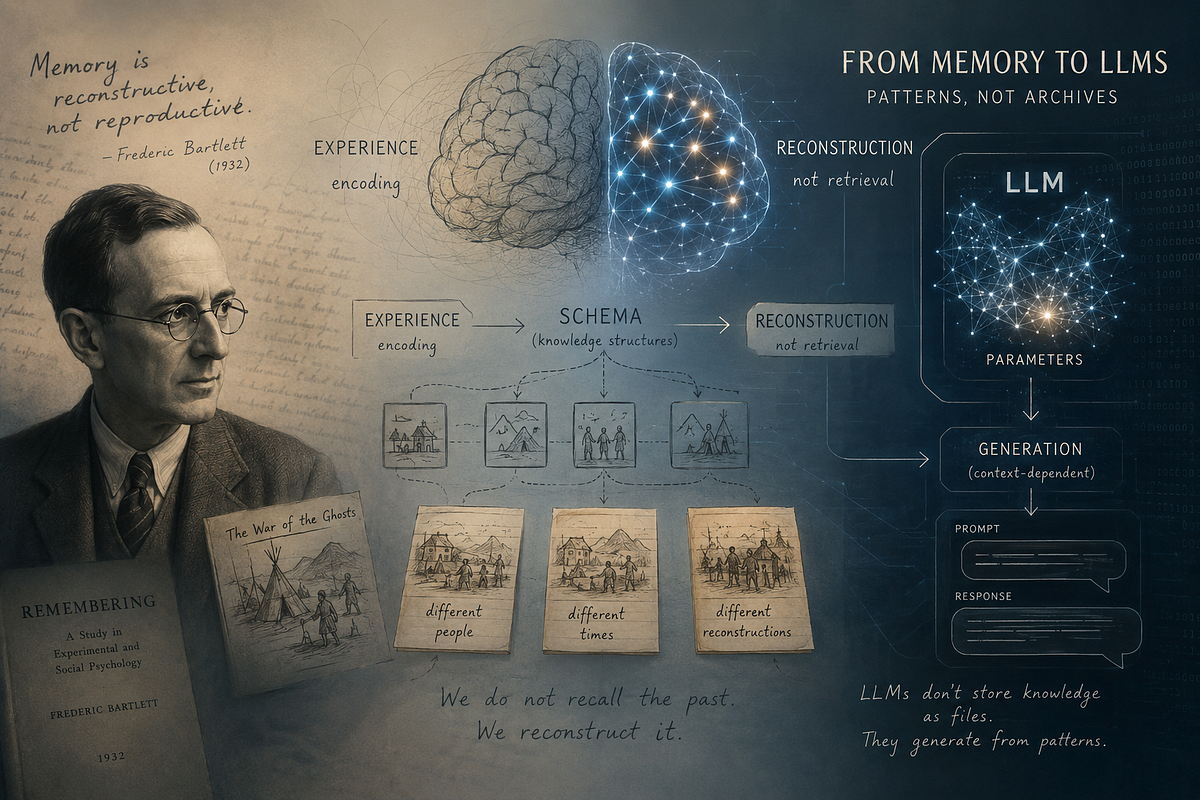
Researchers are revisiting the work of Frederic Bartlett, a psychologist who in 1932 proposed that memory isn’t about storing experiences like an archive, but reconstructing the past based on existing knowledge. Bartlett’s experiments involved asking participants to retell stories, revealing they simplified details and replaced unfamiliar elements with culturally relevant ones, demonstrating memory as a reconstructive process rather than a perfect recording.
This concept resonates with how modern large language models (LLMs) like ChatGPT function. LLMs don’t retrieve information from a stored database, but generate responses based on learned patterns and relationships within data.
While the mechanisms differ between the human brain and AI, both rely on patterns and reconstruction to produce outputs, rather than simple recall. The implications extend beyond memory itself, raising questions about identity, if memories are constantly rebuilt, what constitutes the self? and the very nature of knowledge in both humans and machines. The focus is shifting from knowledge as static storage to knowledge as dynamic pattern recognition.
Surfaced by the Discovery lens — one of the vital signs ovr.news reads.
AI summary
read the original for the full story — Read on andriantriputra.medium.com . How we work →